
By Me/Self Image Magazine
The Warfare Issue/ November 2026
Article Song
Listen to the Article Part 1
Listen to the Article Part 2
The first thing you notice when you get to Capernaum is the air. Because the Sea of Galilee sits 700 feet below sea level, tucked deep down inside a valley surrounded by steep hills, the air down here is heavy and warm. You feel it on your skin the second you step out.
When you walk down toward the water, a warm breeze comes off the lake. It smells like wet rock, dirt, and wild mustard plants, mixed with the clean scent of eucalyptus trees and sweet pink oleander bushes growing along the shore.
Everything around you is a mix of old and new. The ground under your feet is covered in rough black volcanic rock—basalt—that comes right out of the earth here. Just down the shoreline, there’s a Greek Orthodox church with bright white walls, pink domes, and bright pink bougainvillea bushes spilling over the stone fences. On the other side of the grounds, Franciscan friars walk around quietly in their brown robes tied with white rope belts.
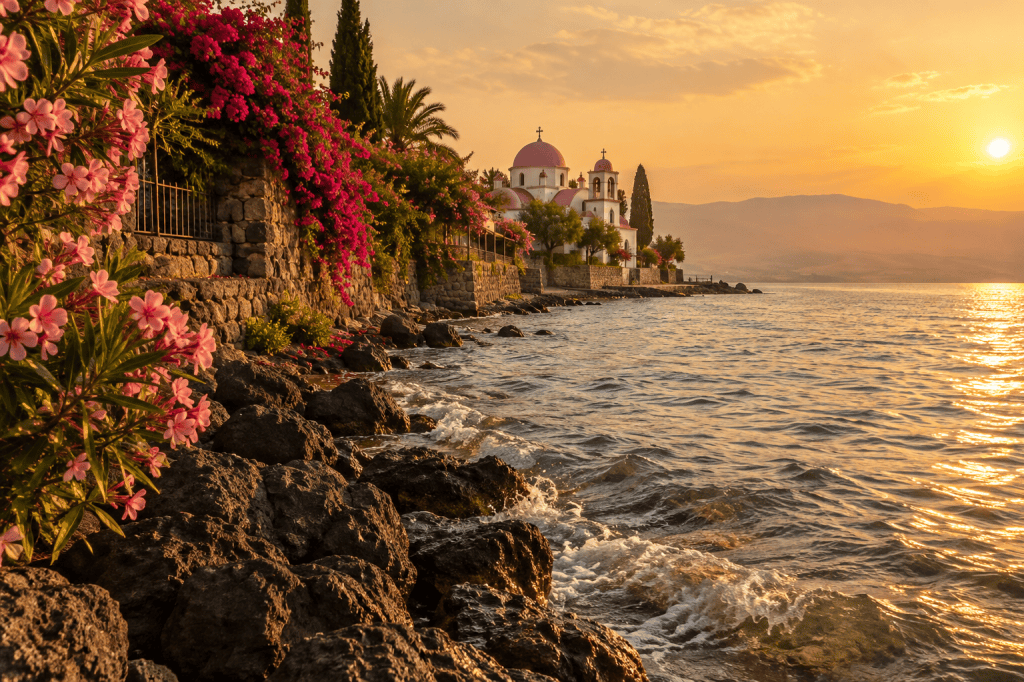
The paths are full of people from all over the world, and nobody is in a hurry. You see Orthodox men in black hats, local Israelis in casual linen shirts and sandals, and travelers in dusty boots carrying worn-out Bibles. Women drape scarves over their shoulders out of respect before walking into the holy areas. You hear people talking in Hebrew, Arabic, Spanish, and English, but nobody is loud. Everyone speaks in low whispers. There’s a heavy respect in the air. People walk slow here because they’re actually taking it in.
And then it hits you where you actually are. You are breathing the exact same air, looking at the exact same hills across the water, and walking the same dirt that Jesus walked two thousand years ago.
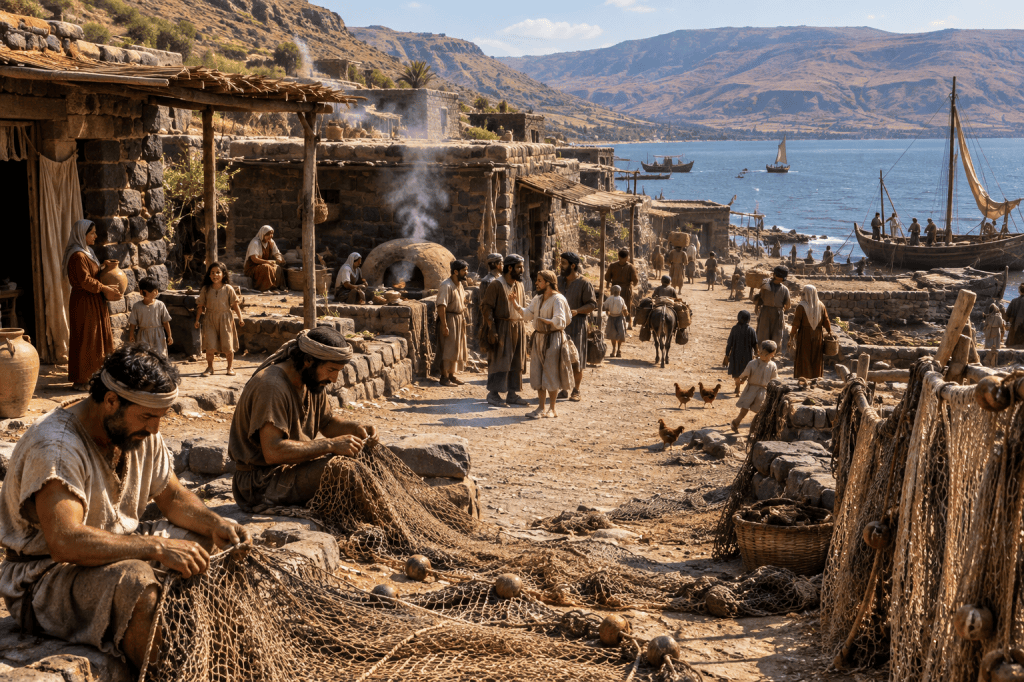
If you take away the fences and the shade trees and picture what Capernaum looked like when Jesus moved here and made it His home base, it wasn’t a quiet park. It was a loud, busy, hot fishing town of about 1,500 people.
Back then, there weren’t any fancy palaces here. The town was just narrow dirt streets packed with low, flat-roofed houses made out of those same rough black rocks, held together with mud and pebbles. Families lived crowded together around shared courtyards. If you walked down the street back then, you would have smelled woodsmoke coming out of clay ovens, fresh flatbread baking, fish drying in the sun, sweat, and olive oil. You would have walked right past fishermen with rough, calloused hands and sunburned skin wearing simple tunics, sitting by the water fixing their nets. You would have heard women grinding grain on heavy black stones, kids running barefoot in the dirt, and Roman soldiers and tax collectors—like Matthew, who had his tax booth right here in town—watching the road.
Right in the middle of town is the synagogue.
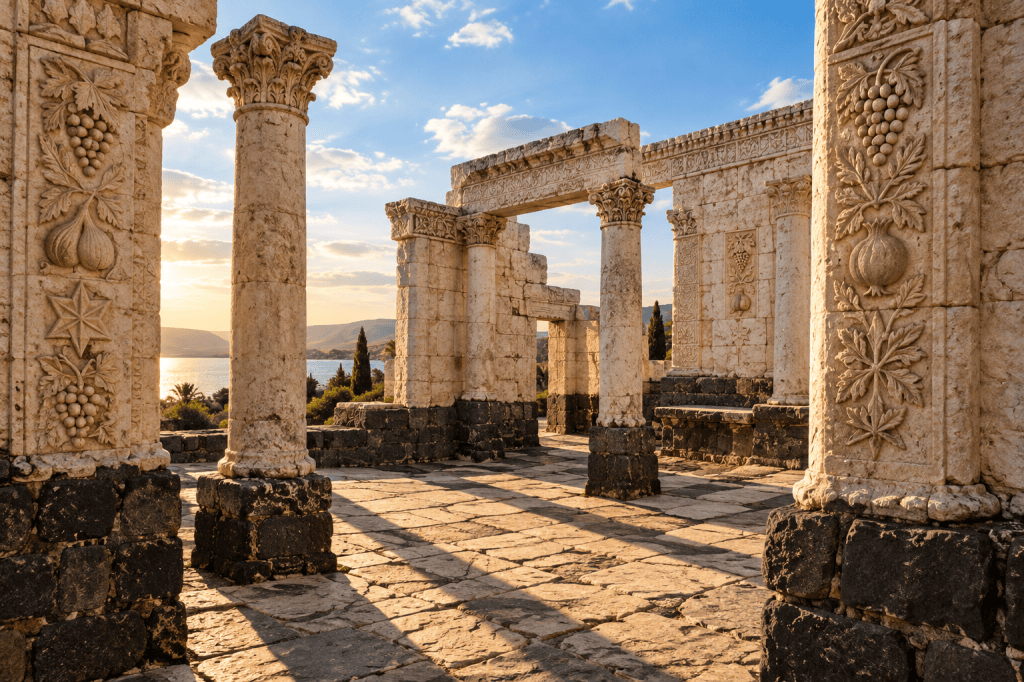
Today, it doesn’t have a roof. It’s open to the sun and the sky. What you see standing there now are the tall white limestone walls and pillars from a synagogue built in the fourth century. You can still see carvings of figs, pomegranates, grapes, and stars cut right into the white stone.
Look down at the bottom of the walls, though. Right underneath that white stone is a thick, dark foundation made of black rock. That black rock is the original first-century synagogue.
Even though it’s ruins now and doesn’t hold regular services like a modern church, it doesn’t feel dead at all. People still come here for the exact same reason they did two thousand years ago.
When you walk inside those four walls, you see people sitting quietly on the stone benches along the sides with tears rolling down their faces. Sometimes a small group will stand in the middle of the floor reading the Bible out loud or singing softly.
Think about how crazy it is to stand on that floor. That is the exact spot where Jesus stood on the Sabbath, opened the scrolls, and said, “I am the bread of life.” Right inside this room, a man with an unclean spirit screamed at Him, and Jesus didn’t back down—He told the spirit to come out, and set the man free right there in front of everybody.
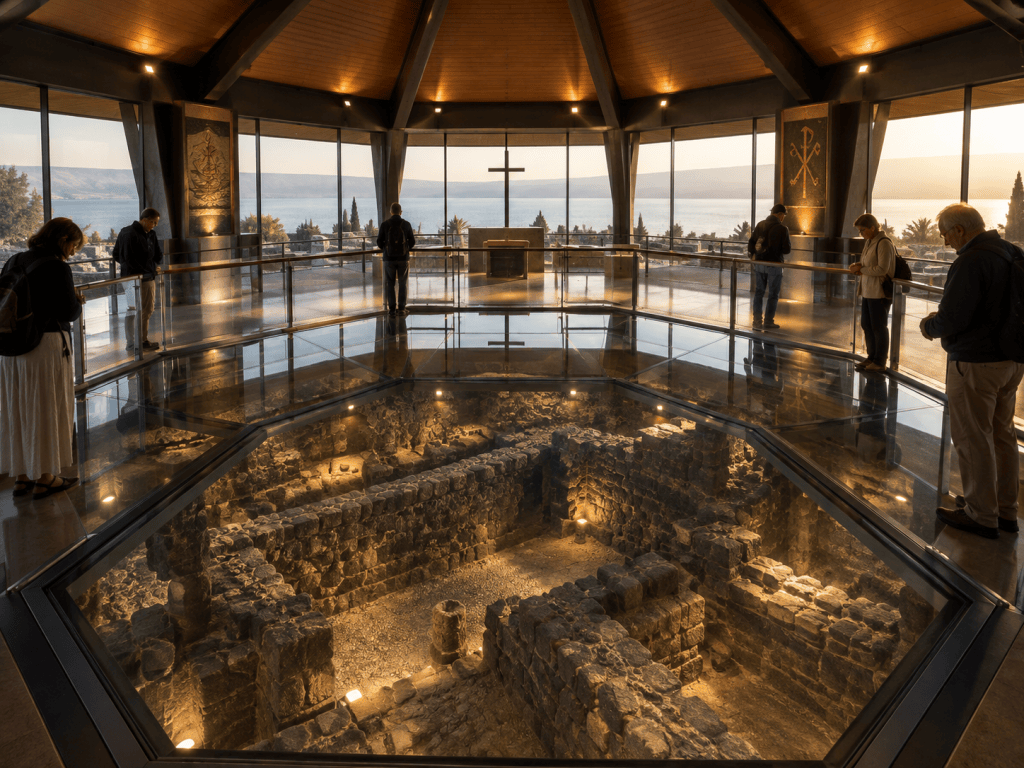
When you walk out the front of the synagogue, you take maybe fifty steps toward the water and you’re standing at the black stone walls of Simon Peter’s house. He lived right next door. This is the actual house where Jesus walked in after synagogue, grabbed Peter’s mother-in-law by the hand when she was burning up with a fever, and healed her. It’s the same place where men tore a hole through the mud roof to lower their paralyzed friend down in front of Jesus because the doorway was too packed with people to get through. Now, they have a modern eight-sided church built up on pillars right over the ruins, with a glass floor in the middle so you can look straight down into the rooms where Jesus ate and stayed with His disciples.
Just past Peter’s house, the town meets the water. Small, clear waves from the Sea of Galilee hit the black rocks on the shore.
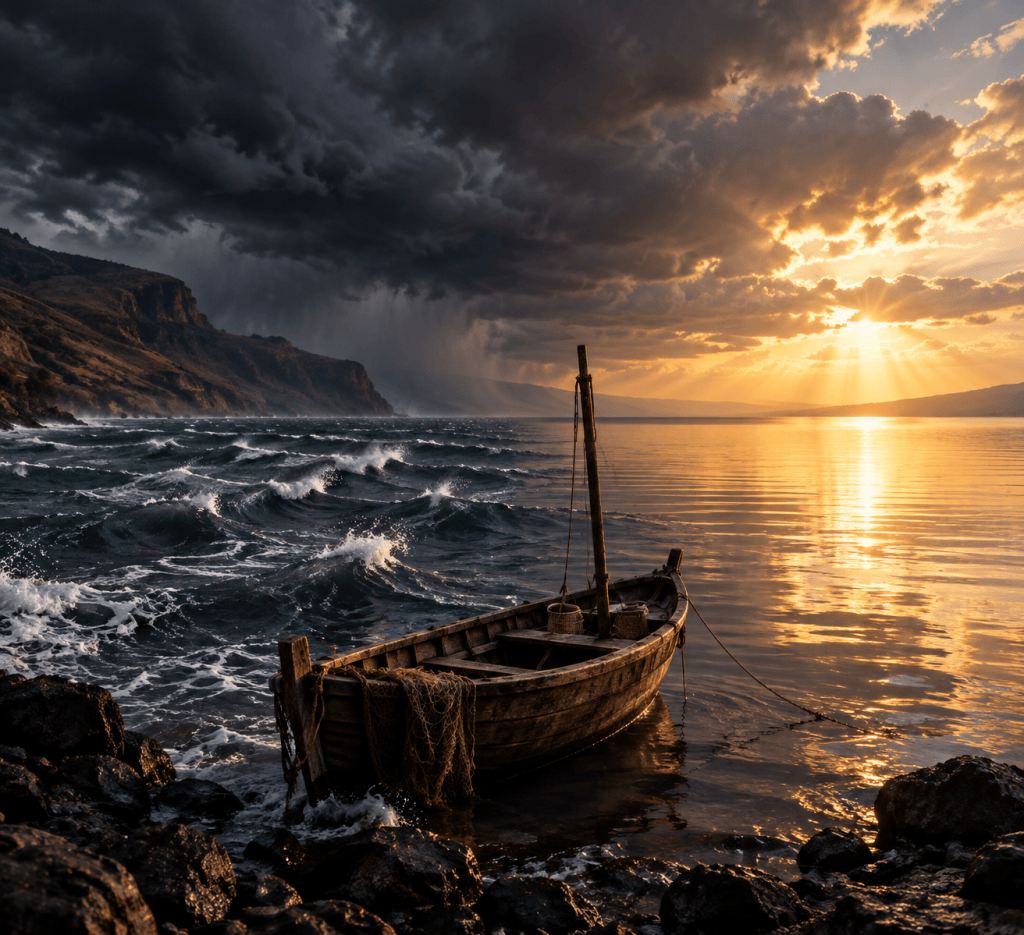
Across the lake, you can see the steep cliffs of the Golan Heights. Because of how high those mountains are, cold air from the top can drop down fast and hit the warm air sitting over the water. Out of nowhere, the wind will whip that calm lake into a violent storm in a matter of minutes.
Looking out at that water makes the Bible feel so real. That is the exact lake where Jesus was asleep on a cushion in the back of a wooden boat while a storm was flooding the deck and terrifying His disciples. That is where He stood up in the middle of the wind and waves, said, “Peace, be still,” and the water went completely flat. That is the same water He walked on in the middle of the night when He reached out and caught Peter as he started to sink.
So much of the world right now tries to make us feel like we are too far gone, or like the Bible is just a bunch of made-up stories.
Standing in Capernaum kills that lie.
There is real dirt here. There are real black stones you can touch with your hands. You can feel the wind coming off the water. We haven’t lost our history. Jesus was real. He was actually here. He breathed this warm air, stood on that black stone floor, healed hurting people in these cramped little houses, and told the storms on this lake to quiet down. And the same Jesus who walked the dirt streets of Capernaum is still real, and still calming the storms in our lives today.

