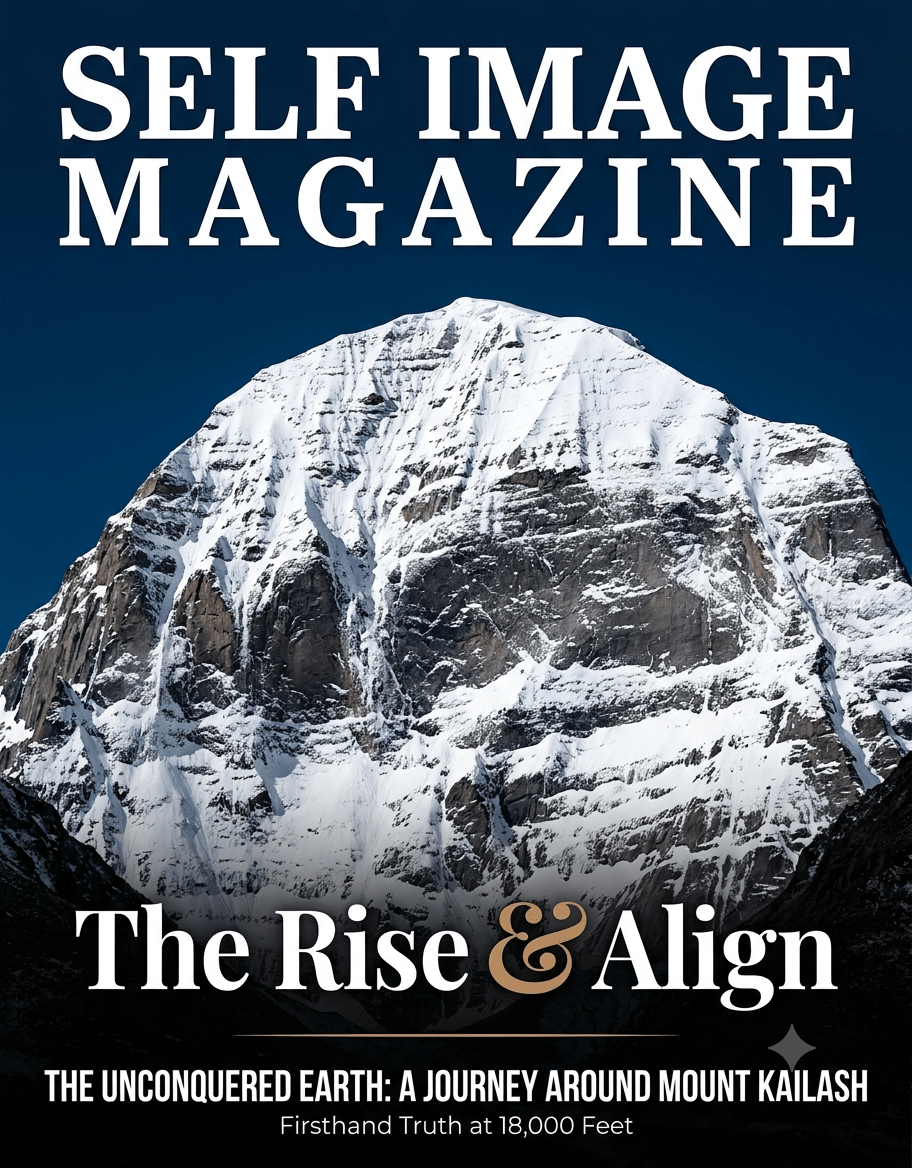
By Me Self Image Magazine
Rise and Align
Listen to the article song:
Listen to the article:
The Thin Air of the Plateau
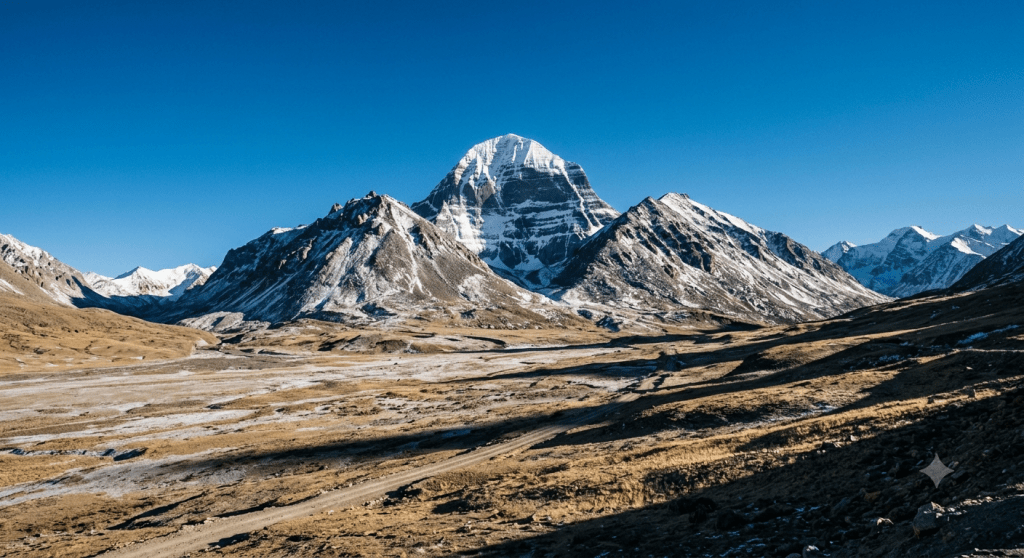
The transport engine cut off, and the silence of the high plateau rushed in to fill the void. Stepping onto the frozen dirt outside Darchen, the atmosphere didn’t gently greet me—it hit the back of my throat like a cold blade. At 15,000 feet, you don’t take air for granted. Every breath requires conscious effort, forcing an immediate, deliberate awareness of your own lungs. The sunlight cuts through the thin sky with blinding clarity, making the deep azure above and the primary colors of prayer flags—blue, white, red, green, and yellow—look impossibly vivid against the jagged, barren rock.
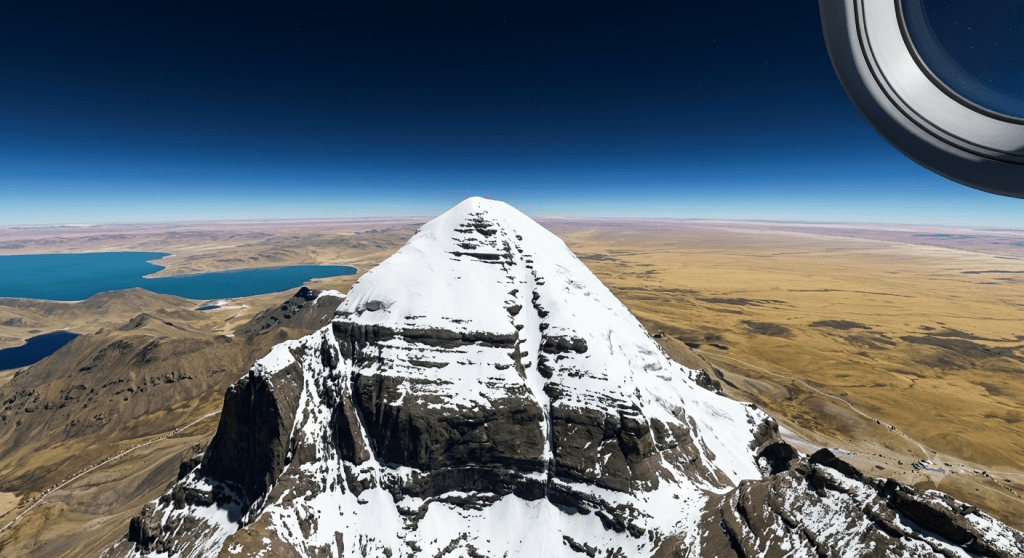
In a world obsessed with commercialized, high-status peaks—where modern mountaineers pay small fortunes to drag their egos up crowded paths just to snap a photo and leave trash—Mount Kailash stands as a quiet rebuke to human pride. Standing at 22,778 feet, Kailash has never been summited. Out of deep reverence across ancient spiritual traditions, no human foot touches its peak. You do not conquer this mountain; you submit to its presence.
I hadn’t come to climb. I had come to walk the Kora—the 32-mile spiritual circuit around the base—and observe the earth with the eyes God gave me, completely unfiltered by mainstream institutional narratives, textbook theories, or distant maps.
Bread, Tea, and the Dirt Track
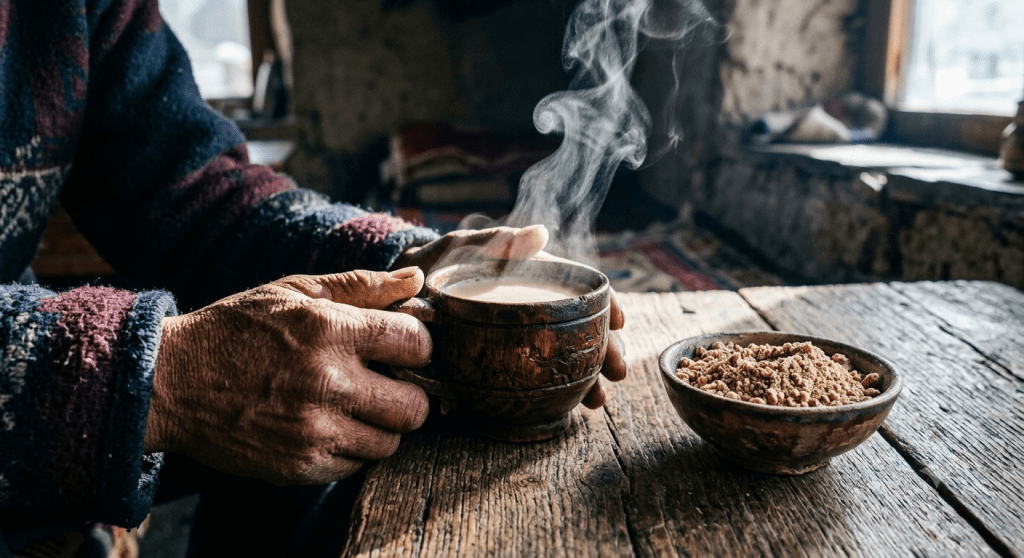
Before setting out, I met Tenzin, a local villager whose weathered skin bore the deep lines of a life lived under the high-altitude sun. He didn’t offer a corporate tour or a polished brochure. He simply nodded, gestured toward the dirt track, and invited me to walk alongside him and his family.
We paused early near a small stone shelter to prepare for the trail ahead. Tenzin reached into his pouch and produced a bowl of Tsampa—a traditional Tibetan staple made from roasted barley flour kneaded by hand with warm water and fresh yak butter into small, dense balls. It has a rich, nutty, slightly salty taste that grounds your stomach instantly. He poured me a wooden cup of Po Cha (Butter Tea), churned with salt and yak butter. It isn’t sweet; it’s thick, savory, and greasy, specifically crafted to keep lips from cracking in the biting wind and to fuel the body through intense cold.
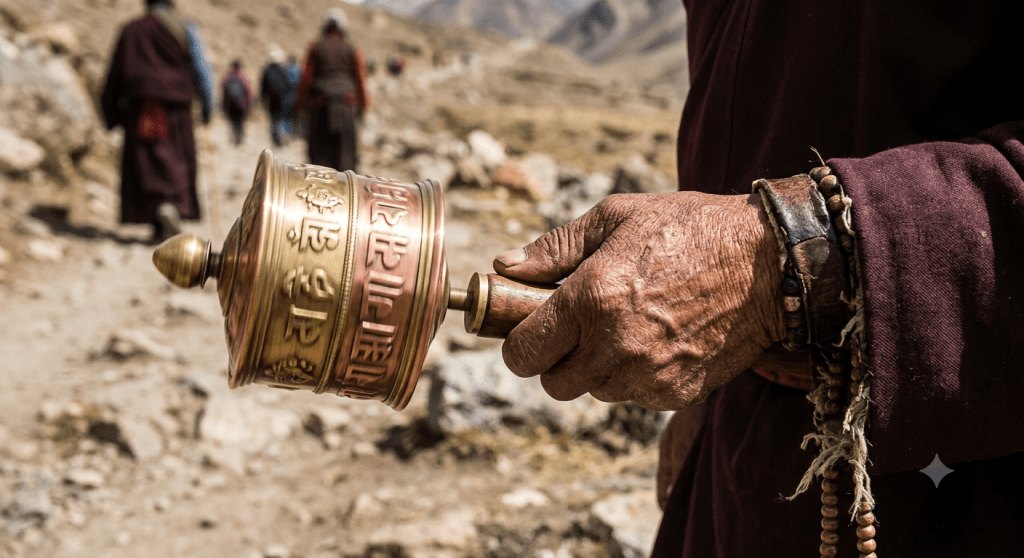
Sitting there, feeling the warmth of the cup in my hands, the low-vibration noise of modern society began to fade. The soft, rhythmic scrape of leather boots on gravel accompanied the low, resonant hum of wooden prayer wheels spinning on copper axles.
“Why must the peak remain untouched?” I asked Tenzin, looking up at the snow-capped face towering above us. “In the West, people measure value by conquest—by scaling the highest point and planting a flag.”
Tenzin looked toward the mountain with a quiet, practiced reverence. “To climb it is to demand that creation serve your pride,” he said. “Kailash is the physical center of the earth for our people—the axis where heaven and earth meet. Leaving it untouched is how we show that human authority has limits. You do not master what God created to master you.”
The Mechanism of Intention and the Dust
As we stepped back onto the frozen trail, every pilgrim we passed held a small, spinning cylinder of brass and wood, keeping it in a steady, clockwise motion as they walked.
“What is inside those?” I asked, watching Tenzin’s mother effortlessly keep her wheel turning in the biting wind.
“Inside the wheel is a tightly rolled scroll,” Tenzin explained, holding up his own wooden cylinder. “It contains thousands of sacred prayers written by hand. When you spin it, you do not just speak words into the air with a quiet voice. You use your physical strength to move the truth through the world. The hands, the mind, and the movement of the earth become one single action.”
Watching them spin, it struck me how far removed this was from the passive, disembodied ways modern institutions teach us to exist. It wasn’t abstract rhetoric—it was a deliberate, physical discipline meant to anchor the mind to direct, tangible reality.
A few yards ahead, another pilgrim was moving along the path in a rhythm unlike anything seen in Western athletic trials. The man touched his palms overhead, brought them to his chest, dropped to his knees, and extended his entire body flat onto the sharp gravel, stretching his arms forward to mark the dust with his fingertips before standing up, taking three steps, and repeating the process.
“Why do they move like this?” I asked Tenzin. “Is it a penance?”
Tenzin paused before answering through our shared silence. He explained that the physical act of dropping to the ground isn’t about punishment—it is about Total Truth and Alignment:
* Purification of Ego: Laying the chest flat against the cold earth is a literal dismantling of human pride. It is a physical statement that personal status and ego have no authority before creation.
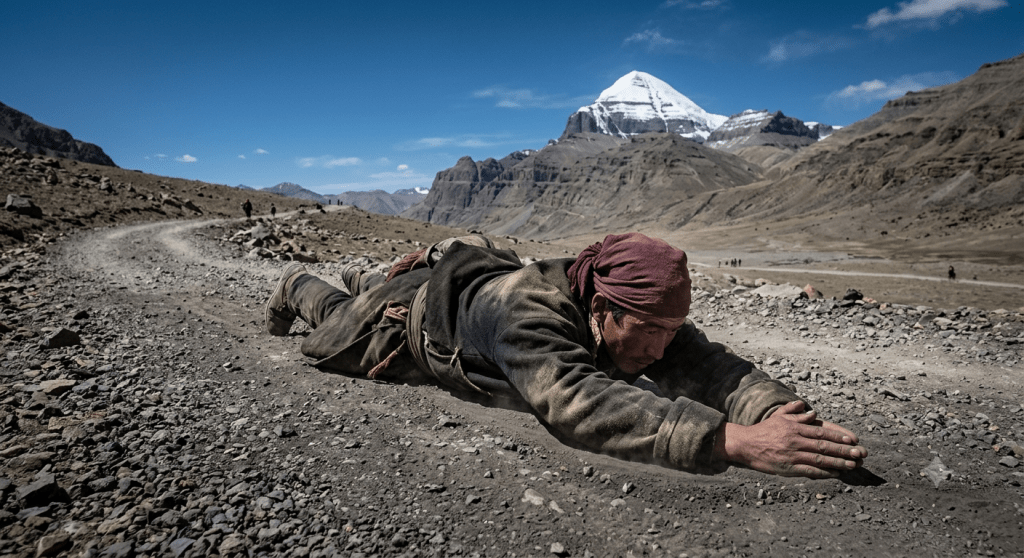
* Direct Submission: Bringing the forehead to meet the dust forces the mind to acknowledge human mortality and surrender the delusion of control.
* Unified Intention: Every footstep and drop to the earth synchronizes internal conviction with physical movement.
Seeing this unfold reframes everything mainstream systems teach us about strength. We are told that dominance is about forcing an outcome and imposing your will on nature. But standing on that trail at 18,000 feet, watching people bow into the dust, reveals that true dominance is internal discipline. It takes real authority to surrender your pride and stand—and kneel—in alignment with reality.
What Books Cannot Teach
Near the highest point of the circuit, I stopped and looked out across the horizon. The vast, level expanse stretched out beneath a dome of deep blue air, raw and visible to anyone willing to trust their own senses over institutional doctrine.
“When you look at this landscape,” I asked Tenzin, “what do your eyes and your body tell you that a map or a classroom textbook never could?”
Tenzin smiled, gesturing to the wind whipping through the pass. “A book gives you someone else’s idea of the world,” he said. “It gives you lines drawn by men who have never stepped in this dirt. But your body feels the pressure of the air. Your eyes see the horizon as it is given to you. The mountain does not lie to you, and the ground beneath your boots does not change because a institution printed a diagram.”
His answer cut right to the core of everything we lose when we trade direct human observation for corporate and academic consensus.
The Descent to Reality
By the time Tenzin and I crossed the grueling Dolma La Pass and descended back into the valley, my body was physically spent, but my mind was completely still.
Sitting on the long journey home, watching the high ridges recede, the artificial demands of modern life—the media chatter, the state-driven narratives, the pursuit of empty status—felt faint and entirely irrelevant.
Walking around that sacred mountain didn’t leave me with a physical trophy to display on a wall. It left me with an unshakable internal compass. Once you have used your own eyes to observe the world as it truly is, trusted the senses God gave you, and aligned yourself with the ground beneath your feet, you can no longer go back to living a lie.

